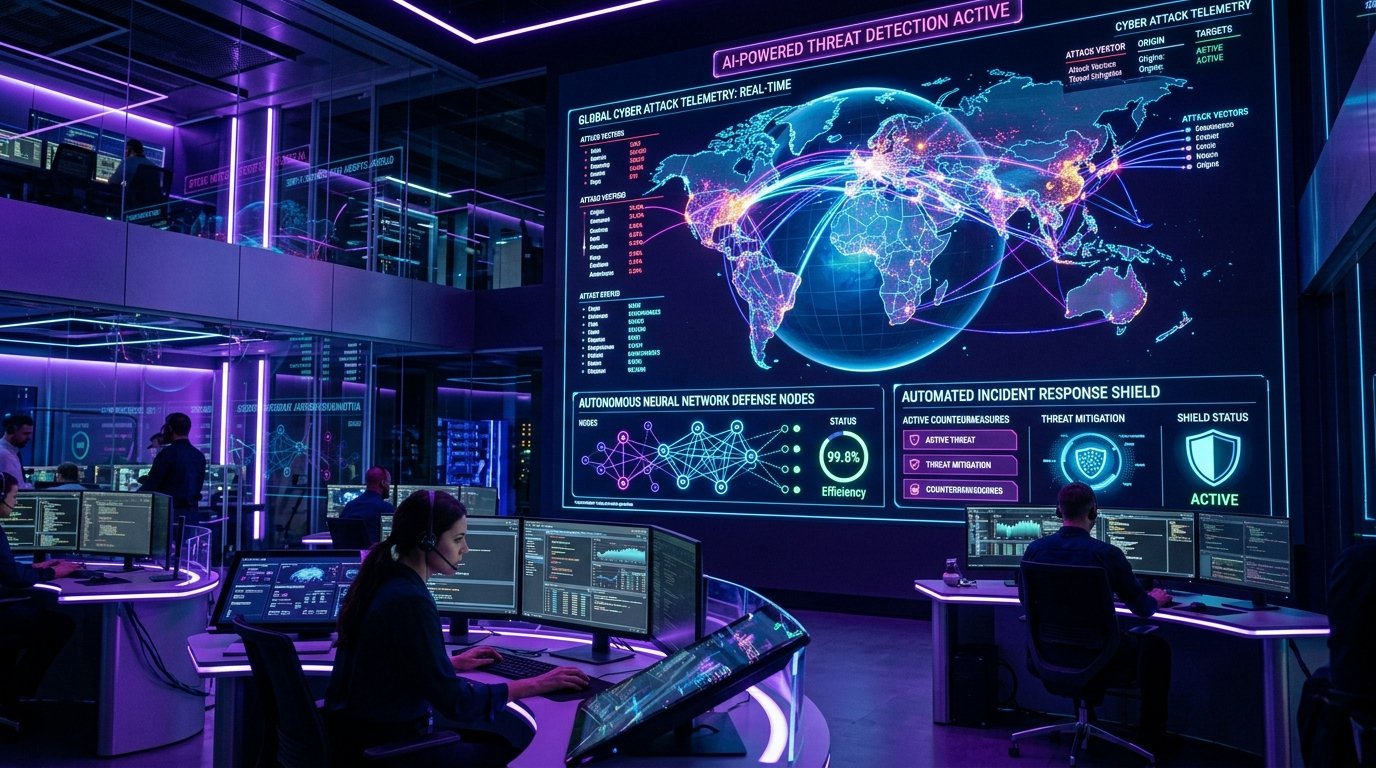
In 2026, cybersecurity is no longer a human-scale challenge. Adversaries are launching automated multi-vector campaigns, weaponizing generative AI to execute autonomous reconnaissance, synthetic identity deception, and polymorphism at velocities impossible for human analysts to counter manually. As enterprise data expands across hybrid clouds, microservices, and distributed workforces, traditional Security Operations Centers (SOCs) have reached a breaking point. Enter AI-Powered Threat Detection & Autonomous SOC architectures—the definitive evolution of modern enterprise cyber defense.
Key Takeaways: The 2026 Autonomous SOC Paradigm
- Machine-Speed Defense: Machine-driven cyber threats necessitate sub-second autonomous detection and remediation.
- Noise Elimination: Cognitive AI triage filters out up to 85% of false positives, shielding analysts from debilitating fatigue.
- Cross-Domain Telemetry: Unifies endpoint, identity, cloud, and network signals into single-pane, high-fidelity incident timelines.
- Human-in-the-Loop Synergy: Frees senior cyber engineers from rote triage to focus on proactive threat hunting and systemic cyber resilience.
- Measurable Impact: Slashes Mean Time to Detect (MTTD) from days to seconds and Mean Time to Respond (MTTR) from hours to minutes.
The Breaking Point of Traditional Security Operations Centers
For more than a decade, enterprise SOC operations followed a predictable blueprint: ingest terabytes of log data into a Security Information and Event Management (SIEM) tool, configure correlation rules, and assign Tier-1 analysts to triage the relentless flood of generated alerts. In 2026, this reactive methodology has collapsed under three critical pressures:
- Crushing Alert Fatigue: The average enterprise SOC generates between 10,000 and 25,000 security alerts every 24 hours. Over 70% of these alerts are benign anomalies or duplicate false positives, causing critical indicators of compromise (IoCs) to slip through unnoticed.
- Asymmetric Attacker Velocity: Modern ransomware groups and state-sponsored APTs automate exploitation chains using LLM-generated code and automated lateral movement tools. When attackers pivot within your network in under 8 minutes, an analyst responding in 4 hours arrives far too late.
- The Chronic Cyber Talent Shortage: Tier-1 analyst roles suffer unprecedented burnout and turnover rates. Building a 24/7/365 internal SOC requires a minimum of 10 to 12 experienced shifts, a cost that strains even Fortune 500 IT budgets.
What is an Autonomous SOC in 2026?
An Autonomous SOC does not simply replace manual steps with rigid scripting. Unlike legacy Security Orchestration, Automation, and Response (SOAR) playbooks that break when edge cases arise, an autonomous SOC incorporates agentic AI, machine learning classifiers, and deep contextual reasoning to autonomously execute the entire investigative lifecycle:
Autonomous Triage & Enrichment
Incoming telemetry is instantly cross-referenced against global threat intelligence feeds, MITRE ATT&CK frameworks, and asset criticality scores within milliseconds.
Cognitive Root-Cause Analysis
AI agents reconstruct the attack chain from initial phishing vector or API vulnerability through lateral traversal, pinpointing root causes with zero manual log queries.
Automated Micro-Containment
Compromised endpoint processes are frozen, rogue authentication tokens revoked, and firewall micro-segmentation applied dynamically before data exfiltration occurs.
Core Architectural Pillars of AI-Powered Detection
Modern AI threat detection relies on four foundational technological pillars that operate in tight synchronization:
1. User & Entity Behavior Analytics (UEBA 2.0)
Static rules ("trigger alert if user logs in from new country") generate endless false alarms for travel and VPN usage. 2026 UEBA models build deep mathematical profiles of normal organizational behavior across keystroke patterns, access timing, data transfer velocity, and API token usage. Subtle deviations—like an engineer's credentials accessing sensitive HR buckets at 2 AM—trigger calibrated containment immediately.
2. Cross-Domain Extended Detection & Response (XDR)
Threat actors rarely attack in a silo. A sophisticated breach spans identity spoofing in Microsoft Entra, privilege abuse in AWS IAM, and execution on a developer laptop. AI models fuse disparate logs into a unified, contextual graph of adversary activity rather than 15 detached alerts.
3. Generative Cyber Reasoning & Natural Language Queries
Modern SOC teams interact with autonomous co-pilots using natural language: "Show all lateral movement attempts originating from the marketing subnet in the last 72 hours and summarize outbound data transfers." The AI synthesizes actionable, audit-ready reports complete with remediation scripts in seconds.
4. Self-Healing Posture & Automated Remediation
Once an intrusion vector is blocked, the autonomous engine can automatically patch the exploited configuration, roll back encrypted files to their clean shadow state, and push updated zero-trust rules across the perimeter.
Traditional SOC vs. Autonomous SOC: Side-by-Side Comparison
| Operational Metric | Traditional SOC (Manual / Rules) | Autonomous AI SOC (2026 Standard) |
|---|---|---|
| Mean Time to Detect (MTTD) | Hours to Days (Average: 197 days) | Sub-minute (Seconds) |
| Mean Time to Respond (MTTR) | 4 to 24 Hours | Under 3 Minutes (Automated) |
| Alert Triage Capacity | 15–30 alerts per analyst/shift | Unlimited concurrent telemetry streams |
| False Positive Suppression | Poor (Analyst fatigue high) | Up to 85% filtered via cognitive AI |
| Zero-Day & Fileless Defense | Blind until signatures are published | Behavioral & heuristic anomaly detection |
| Staffing Requirement | 10–15 Tier-1/2 Analysts round-the-clock | Lean senior team focused on hunting & architecture |
The Hybrid Paradigm: Human-in-the-Loop Governance
A common apprehension among CISOs is whether fully autonomous systems risk disrupting critical business operations through accidental shutdowns. In 2026, leading organizations implement a calibrated autonomy governance model:
- Level 1 (Full Autonomy): Reversible actions such as terminating suspicious user sessions, blocking external malicious IPs, and isolating non-critical endpoints execute automatically with zero latency.
- Level 2 (Supervised Autonomy): High-impact operations—such as isolating a core production database cluster or disabling domain controller links—prepare full forensic justification and await a 1-click verification from a senior security architect.
- Level 3 (Strategic Advisory): Post-incident remediation recommendations, policy adjustments, and architecture hardening are presented as prioritized roadmaps for leadership review.
How Lumiverse Solutions Empowers Your Autonomous Defense
Transitioning from legacy perimeter security to an autonomous security posture requires specialized engineering, continuous telemetry calibration, and seasoned operational oversight. At Lumiverse Solutions Pvt. Ltd., we deliver enterprise-grade SOC capabilities without the prohibitive overhead of internal construction:
- SOC-as-a-Service (SOCaaS): 24/7/365 AI-driven threat surveillance, real-time telemetry correlation, and expert containment engineered for compliance and resilience.
- Managed Detection & Response (MDR): Proactive endpoint and cloud workload protection powered by behavioral threat intelligence.
- Vulnerability Assessment & Penetration Testing (VAPT): Rigorous offensive validation to stress-test detection rules before real adversaries attack.
- Cloud & Identity Security Audits: Hardening your AWS, Azure, and Google Cloud environments against identity-based breaches.
- Regulatory Compliance Frameworks: Comprehensive audit assistance for ISO 27001, SOC 2, DPDP Act, and RBI/IRDAI guidelines.
Conclusion: The Future of Cyber Defense is Autonomous
Cyber adversaries will only accelerate their adoption of automated, AI-driven offense. Attempting to defend human-scale networks with manual human clicks is a losing proposition in 2026. By embracing AI-powered threat detection and autonomous SOC architectures, forward-looking enterprises convert security from an expensive operational bottleneck into a self-defending, resilient business enabler.
Ready to transform your threat detection into an autonomous defense shield?
Connect with our SOC architects at Lumiverse Solutions to schedule a free demonstration and technical security assessment.
Frequently Asked Questions (FAQs)
1. What is an Autonomous SOC and how does it differ from a traditional SOC?
An Autonomous SOC utilizes cognitive AI agents, machine learning correlation, and automated playbooks to detect, investigate, and contain cyber threats in real time without waiting for human Tier-1 triage. While traditional SOCs rely heavily on manual analyst investigation for thousands of raw alerts, an autonomous SOC resolves up to 85% of alerts automatically at machine speed, escalating only complex high-fidelity investigations to senior security architects.
2. How does AI-powered threat detection prevent advanced persistent threats (APTs)?
Traditional signature-based and static rule detection fail against zero-day exploits, fileless malware, and living-off-the-land (LotL) techniques. AI-powered threat detection analyzes behavioral telemetry across endpoints, cloud workloads, identities, and network traffic simultaneously. By identifying subtle contextual anomalies that deviate from baseline behavior, AI spots sophisticated lateral movement and privilege escalation hours or days before manual analysts could notice.
3. Does an Autonomous SOC replace human cybersecurity analysts?
No, an Autonomous SOC does not eliminate human analysts; it empowers them through a hybrid Human-in-the-Loop model. AI takes over repetitive, high-volume Tier-1 and Tier-2 triage, log parsing, and initial containment. Human analysts step up to strategic threat hunting, architectural fortification, adversarial red teaming, and complex business-context decision making.
4. What metrics improve most when transitioning to an AI-driven SOC?
Organizations observe dramatic improvements in Mean Time to Detect (MTTD) dropping from days to seconds, Mean Time to Respond (MTTR) shrinking from hours to sub-minute automated isolation, alert noise reduction exceeding 80%, and virtually eliminating analyst burnout caused by false positive fatigue.
5. How can Lumiverse Solutions help organizations deploy autonomous SOC capabilities?
Lumiverse Solutions provides cutting-edge SOC-as-a-Service and Managed Detection & Response (MDR) equipped with automated correlation engines, 24/7/365 active monitoring, specialized threat intelligence feeds, and certified security engineers—giving enterprises instant next-gen defense without building a multi-million-dollar internal center.